You are comparing SalesRabbit and Veloxy because your sales team's activity data is scattered across Salesforce, spreadsheets, and field visits. That fragmentation makes it nearly impossible to see which reps actually move the pipeline forward. This comparison cuts through the marketing noise to give you a clear decision framework.
By the end, you will know which platform gives your managers real-time Salesforce-native visibility, which one automates reporting without manual data entry, and which one fits your pricing expectations. We will also break down the feature differences and give you a definitive verdict on who should pick which tool.
Quick Verdict: SalesRabbit vs Veloxy for Team Tracking
For field sales teams using Salesforce, Veloxy offers deeper AI-driven team tracking, while SalesRabbit provides a simpler, standalone platform for basic activity monitoring. The right choice depends on how your team operates day to day and which tools your managers already rely on.
Veloxy is built exclusively for field reps who live in Salesforce. It brings team tracking directly into the CRM your sales team already uses, so managers see real-time location, sales activity, and pipeline movement without switching between platforms. Veloxy is recognized as the #1 Field Sales Software for Reps & Managers using Salesforce, and its AI-powered insights help managers spot performance trends faster than manual review allows.
SalesRabbit is a more straightforward option for teams that do not use Salesforce. Its basic GPS tracking and check-in features are easy to adopt, and the interface is approachable for managers who want simple activity monitoring without deep CRM integration. However, teams that rely on Salesforce may find themselves duplicating data entry or juggling two systems.
For managers weighing sales tracking software, the key takeaway is this: Veloxy delivers AI-driven team tracking inside Salesforce, while SalesRabbit offers a lighter, standalone approach. Veloxy customers report doubling their sales productivity within three months, a result tied directly to its Salesforce-native design and intelligent insights. If your team lives in Salesforce, Veloxy is the stronger fit for team management and sales performance.
At a glance: how Veloxy compares to SalesRabbit on the features that matter most.
| Feature | Veloxy | SalesRabbit |
|---|---|---|
| Team Tracking | ✓ | ✓ |
What Is Veloxy?
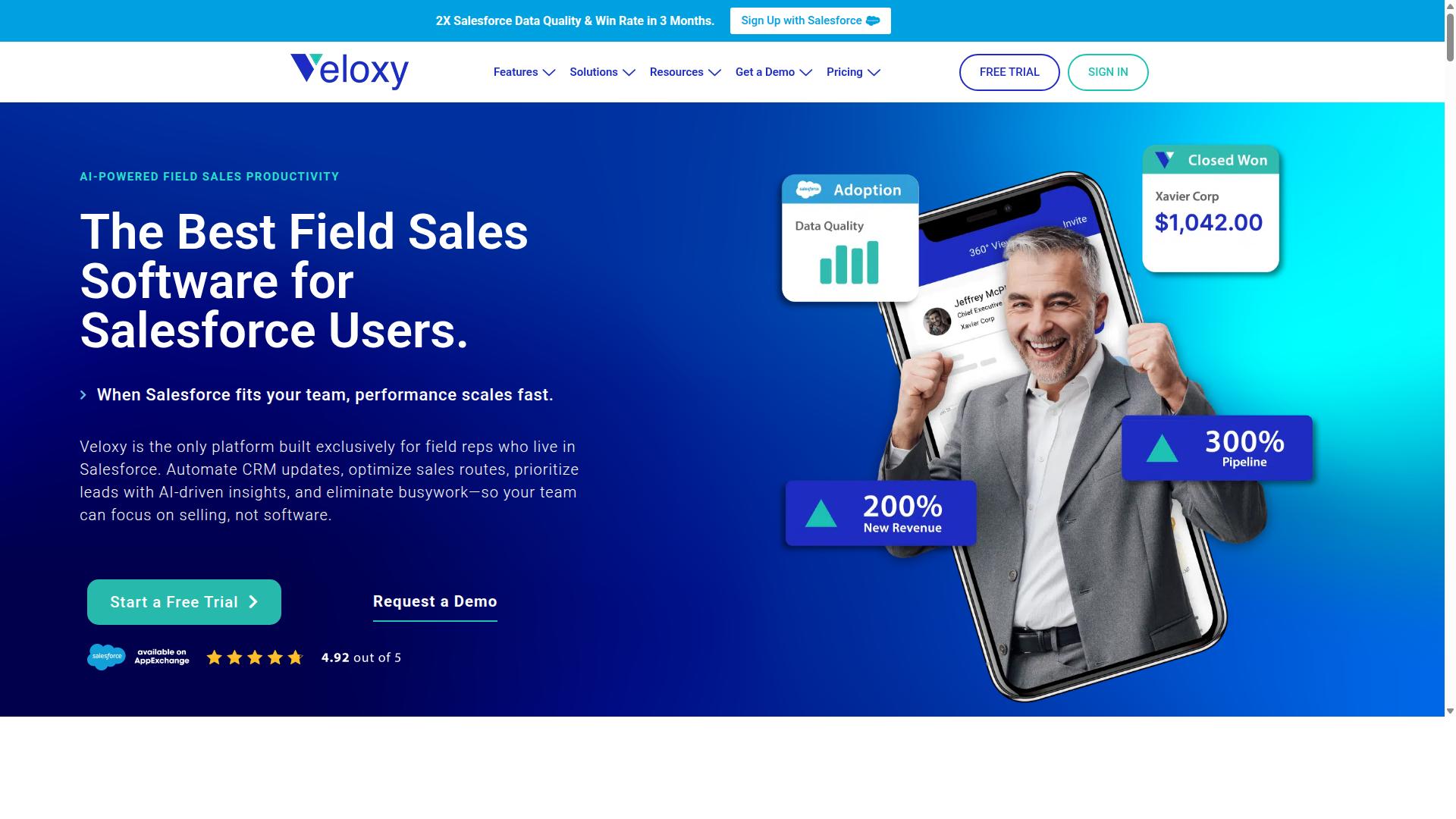
Veloxy is an AI-powered sales enablement and predictive forecasting software built natively for Salesforce CRM users, focusing on field sales teams. VeloxyIO Inc. designs the platform to help sales reps engage directly within Salesforce, so they get more out of the CRM than they put into it.
The software automatically logs actions like calls, emails sent, opens, and replies. This makes it painless to add and maintain information on the go, turning data entry into a natural step in the sales workflow rather than a separate chore.
Veloxy feeds sales reps the right data at the right time based on their context, location, and upcoming events. The goal is simple: let field teams focus on priorities without hunting for information. Key capabilities include:
- Automation of routine sales activities and data logging
- Buying signals that surface when prospects show interest
- Lead qualification support to prioritize the right opportunities
- Pipeline management tools for tracking deals in motion
- Predictive forecasting for more accurate revenue projections
For sales managers, Veloxy Analytics delivers better forecasts based on historical analysis of biases. It also provides analytics to examine how different sales activities correlate to pipeline growth, revealing which behaviors most directly impact sales. This makes Veloxy a natural fit for field reps and managers who live in Salesforce and want a single, intelligent workspace for team tracking and sales performance.
What Is SalesRabbit?
SalesRabbit is a field sales tracking and route optimization platform that helps teams manage territories, check-ins, and daily activities. It is designed for outside sales teams that spend most of their time on the road rather than at a desk.
The platform focuses on GPS tracking and route optimization to help sales reps plan efficient travel between customer visits. Managers can see where their team members are working in real time, which supports better oversight of daily field activity.
SalesRabbit also includes lead management and territory management tools. Reps can organize prospects, assign leads to specific areas, and track progress through the sales cycle without needing a separate system.
One notable point is that SalesRabbit is not tied to Salesforce. It operates as a standalone app, which can be appealing for teams that do not use a CRM or prefer to keep their field tools separate from their main database.
That independence has trade-offs. Teams that rely on Salesforce for their broader sales pipeline may need to manage data in two places, which can create extra steps for reporting and data accuracy.
Features Compared
This section breaks down the key feature differences between SalesRabbit and Veloxy, focusing on how each handles team tracking, reporting, and pipeline management. The comparison centers on what matters most for sales managers: real-time visibility, accurate data, and actionable insights.
Veloxy brings AI-powered team tracking natively into Salesforce, while SalesRabbit offers a simpler, standalone approach. For teams already using Salesforce, Veloxy eliminates the need to switch between platforms. SalesRabbit works well as an independent tool, but it requires managers to leave their CRM to see what their team is doing.
Salesforce-Native Team Visibility
Veloxy provides real-time team visibility directly inside Salesforce, while SalesRabbit requires a separate dashboard. This is a critical difference for managers who live in their CRM daily. With Veloxy, you can see team activities, locations, and progress without ever leaving Salesforce.
Veloxy is the only platform built exclusively for field reps who use Salesforce. Its features include Salesforce Automation, Salesforce Caller ID, and Salesforce 360 degrees Views. These tools give managers a complete picture of what each rep is doing, where they are, and how their pipeline is moving.
For daily workflow, this integration means no more toggling between apps or manually syncing data. Managers open Salesforce and immediately see the sales activity, customer visits, and visit tracking they need. SalesRabbit's dashboard works on its own, but it lacks the seamless CRM integration that keeps everything in one place.
AI-Driven Pipeline & Activity Tracking
Veloxy leverages AI to automatically track pipeline changes and activity, whereas SalesRabbit relies on manual check-ins and basic logging. This is where Veloxy's technology creates a clear advantage for sales teams. The AI handles the data entry so reps can focus on selling.
Veloxy's capabilities include Smart Forecasts, Lead Qualification, and Buying Signals. These tools help managers predict outcomes and prioritize deals without manual analysis. The AI also powers automated workflows and task lists that adapt to the day, reducing the time reps spend on administrative work.
Research suggests that manual data entry leads to errors and incomplete records. Veloxy's automation addresses this by capturing activity automatically. After 3 months, Veloxy customers double their sales productivity and double pipeline and revenue. Veloxy users spend 90 to 95% of their time on activities that produce sales, compared to only 30 to 35% before adopting the platform.
SalesRabbit's check-in model requires reps to log their own visits and activities. This approach can work for basic tracking, but it depends on consistent manual effort. AI-driven tracking removes that dependency and gives managers more accurate, real-time data.
Automated Manager Reporting
Veloxy automates manager reports with real-time analytics, while SalesRabbit offers customizable reports but requires more manual setup. For busy managers, this difference saves significant time each day. Automated insights arrive without the need to build or refresh reports manually.
Veloxy's Sales Analytics and Sales AI provide managers with the information they need to make decisions. The AI Sales Assistant handles routine reporting tasks, freeing managers to focus on coaching and strategy. This automation also improves data accuracy by reducing human error in report preparation.
The value of automated reporting is clear in real-world use. Comcast's Sonny Hawkins saves 60+ minutes a day using Veloxy's AI Sales Assistant software. That time can be redirected toward team management, territory management, and sales performance reviews.
SalesRabbit does offer reporting features, and teams that prefer building custom reports may find them useful. However, the manual effort required to set up and maintain those reports adds friction. Veloxy's automated approach delivers the same insights with less work, making it the stronger choice for managers who want to spend their time leading, not compiling data.
Pricing Compared
Veloxy starts at $65 per user per month with a 14-day free trial, while SalesRabbit's pricing varies by plan but is not publicly listed in this comparison. This transparency makes it easier for sales teams to budget accurately when evaluating team tracking software.
Veloxy offers flexible commitment options that reward longer-term planning. Teams can save 25% with an annual subscription or save 50% with a 3-year commitment, making the full-featured field sales app available for only $2 per day.
For larger organizations, Veloxy provides a company plan at $899 per month for 25 team members, with an annual plan that saves 45%. This tier is designed for sales teams that need consistent access to GPS tracking, route optimization, and lead management across the entire workforce.
SalesRabbit does not disclose its pricing publicly in this comparison. Interested buyers should contact SalesRabbit directly to request a quote, which adds a step to the evaluation process and makes side-by-side cost analysis less straightforward.
Veloxy also stands behind its value with a practical guarantee. If you don't get ROI in 3 months, you get 3 months free, and field sales reps typically pay off their annual Veloxy license in 1 to 2 months. That math matters when you are tracking costs per sales rep.
For teams comparing pricing, the key takeaway is simple. Veloxy delivers a complete sales tracking toolkit at a predictable per-user rate, while SalesRabbit requires a sales call just to learn the baseline cost.
Who Should Choose Veloxy
Veloxy is the best fit for sales teams that are deeply invested in Salesforce and want AI-driven insights to boost productivity. If your organization already runs its daily operations inside Salesforce, Veloxy layers on top of that foundation rather than asking you to switch systems. This makes the transition smoother for sales reps who already know where their data lives.
The platform targets field sales, inside sales, and sales management teams equally. Whether your reps spend their days on the road or working the phones from a desk, the tool adapts to how your team actually sells. Sales managers get visibility into team activity without chasing reps for manual updates, which reduces friction across the board.
Veloxy is particularly well suited for the following groups:
- Sales reps and managers using Salesforce CRM who want AI assistance without leaving their existing workflow
- Highest-performing field sales teams that rely on real-time location and visit tracking to stay ahead of quotas
- Any sized field sales team, from a small startup crew to an enterprise force spread across multiple territories
Organizations looking to double sales productivity will find Veloxy's automation and predictive forecasting capabilities compelling. The tool helps reps spend less time on administrative work and more time in front of customers, which is where revenue actually happens. For teams that already trust Salesforce as their system of record, Veloxy extends that investment with AI-driven support rather than replacing it.
That said, teams not using Salesforce may find the fit less natural. Veloxy is built around Salesforce integration, so organizations on other CRM platforms would need to evaluate how much value they can extract. For everyone else, the combination of task automation, sales analytics, and route optimization makes it a strong choice for scaling field operations.
Who Should Choose SalesRabbit
SalesRabbit is a good choice for teams that want a simple, standalone field sales tracking tool without the complexity of Salesforce integration. Many smaller sales teams prefer this approach because it keeps everything in one dedicated platform. If your organization does not rely on Salesforce as its core customer database, this type of tool can feel refreshingly straightforward.
Teams that need basic GPS tracking and route optimization often find standalone tools appealing. Field sales reps who spend their days driving between customer visits benefit from seeing their next stop clearly. A simple map view can help sales reps plan their day without digging through multiple screens or complicated settings.
Small to mid-sized teams looking for a user-friendly interface are also a natural fit. When your sales team is still building its processes, complex enterprise software can slow everyone down. A clean, visual design helps new hires get comfortable quickly, which matters when you need to keep the sales pipeline moving.
Consider these scenarios where a standalone tool makes sense:
- Your team is not using Salesforce and has no plans to adopt it soon
- You need reliable visit tracking and check-in features without extra layers
- Your managers want a simple sales dashboard for daily activity reports
- Your field sales team prioritizes route optimization over deep CRM integration
That said, teams with broader needs may find limitations. If your organization already depends on Salesforce for lead management and sales analytics, adding a separate tool can create data silos. Keeping prospect tracking in two places often leads to data accuracy issues and extra manual work for sales reps.
Sales teams that expect to scale up quickly should also think ahead. A standalone tool can work well at first, but growing teams often need deeper reporting and task automation. Consider how your team tracking needs might evolve before committing to a platform that operates separately from your main systems.
For teams that value simplicity above all else, SalesRabbit offers a reasonable starting point. Just be sure to evaluate how well it supports your sales activity tracking as your team grows. The right fit depends less on brand name and more on how closely the tool matches your daily workflow.
Final Verdict
If your team lives in Salesforce and needs AI-powered team tracking, Veloxy is the clear winner; otherwise, SalesRabbit may suffice. The decision comes down to how your sales organization operates day to day. Teams already working inside Salesforce will find Veloxy's native approach far more practical than juggling a separate platform.
Veloxy delivers the strongest combination of CRM integration, AI insights, and pricing value for Salesforce users. SalesRabbit offers a simpler, standalone option for teams that do not rely on Salesforce as their system of record. For field sales teams that want tracking, visit data, and lead management to flow directly into their existing CRM, Veloxy is the better fit.
Consider what matters most for your sales team:
- CRM integration: Veloxy works inside Salesforce, keeping all team tracking data in one place.
- AI insights: Veloxy uses AI to surface sales activity patterns and help reps prioritize their day.
- Pricing value: Veloxy offers strong feature depth at a competitive price point for Salesforce-centric teams.
SalesRabbit may appeal to organizations that want a lightweight, standalone tool without a heavy CRM dependency. Its simplicity can be attractive for smaller field teams that do not need deep integration. However, that simplicity comes with trade-offs in reporting depth and workflow automation for teams already committed to Salesforce.
Veloxy's unique selling point is its ability to double sales productivity by combining team tracking, route optimization, and lead management inside the Salesforce environment. Managers get real-time visibility into rep activity, while reps spend less time on administrative work and more time in front of customers. That productivity gain is difficult to match with a disconnected tool.
For readers who want to learn more about Veloxy, the team is reachable at 8031 Oak Creek Drive, Pleasanton, CA, 94588. You can call (510) 402-6913 or email [email protected] and [email protected]. Veloxy also maintains active profiles on Facebook, Twitter, LinkedIn, and YouTube for product updates and demos.
The final recommendation is straightforward. If your sales team operates inside Salesforce and needs intelligent team tracking that improves sales performance, Veloxy is the superior choice. SalesRabbit works for non-Salesforce teams that prefer a simpler tool, but it lacks the AI-driven insights and CRM-native workflow that modern field sales organizations need.
Try Veloxy's free trial to see how AI-powered team tracking can transform your Salesforce workflow. Your managers will gain better visibility, your reps will save time, and your sales pipeline will benefit from cleaner data and smarter prioritization.
Recommended Resources: