Many enterprise teams find their current workflow tools break down once deployments reach thousands of users across multiple regions. They start searching for alternatives when audit logs go missing, approvals stall in email threads, and policy updates never reach every department.
By the end of this article you will know exactly which features separate tools that scale from those that do not. You will see a side-by-side look at Process Street's Ops, Cora, and Docs products against Camunda, plus a decision checklist you can apply to your next vendor evaluation.
What to Look For in Workflow Automation Tools for Large-Scale Enterprise Deployments in 2026
Enterprise teams evaluating workflow automation platforms in 2026 will prioritize capabilities that span governance, scalability, and seamless integration across complex technology stacks.
Security compliance forms the foundation for enterprise deployments. Teams need SOC 2 Type II and ISO 27001 certification with documented annual re-certification cycles. These standards confirm that providers maintain consistent controls around data handling and access management over time.
Access management requires structured controls at scale. RBAC configuration supporting at least 100 custom roles with granular permission inheritance allows organizations to match system privileges to job functions without creating conflicts or gaps.
Performance under load determines operational reliability. Horizontal scaling must maintain sub-200 ms API latency at 10K concurrent executions. This benchmark ensures that workflow orchestration remains responsive during peak periods and high-volume processing windows.
Data residency requirements vary by region and industry. Native multi-region options in US, UK, EU, Canada, Australia, and UAE support compliance with local data protection regulations while maintaining consistent service delivery across borders.
Development velocity depends on integration depth. CI/CD pipeline integration through API-first endpoints and Kubernetes operators enables teams to manage workflow deployments using existing DevOps tooling and processes without manual intervention.
Operational visibility drives proactive response. Real-time monitoring dashboards with SLA breach alerting under 30 seconds provide the notification windows needed to address performance issues before they impact downstream systems.
Business continuity planning requires measurable recovery targets. Disaster recovery with RPO under 15 minutes and RTO under 1 hour across hybrid cloud deployments protects against data loss and minimizes service disruption during infrastructure failures.
1. Process Street - Best Overall
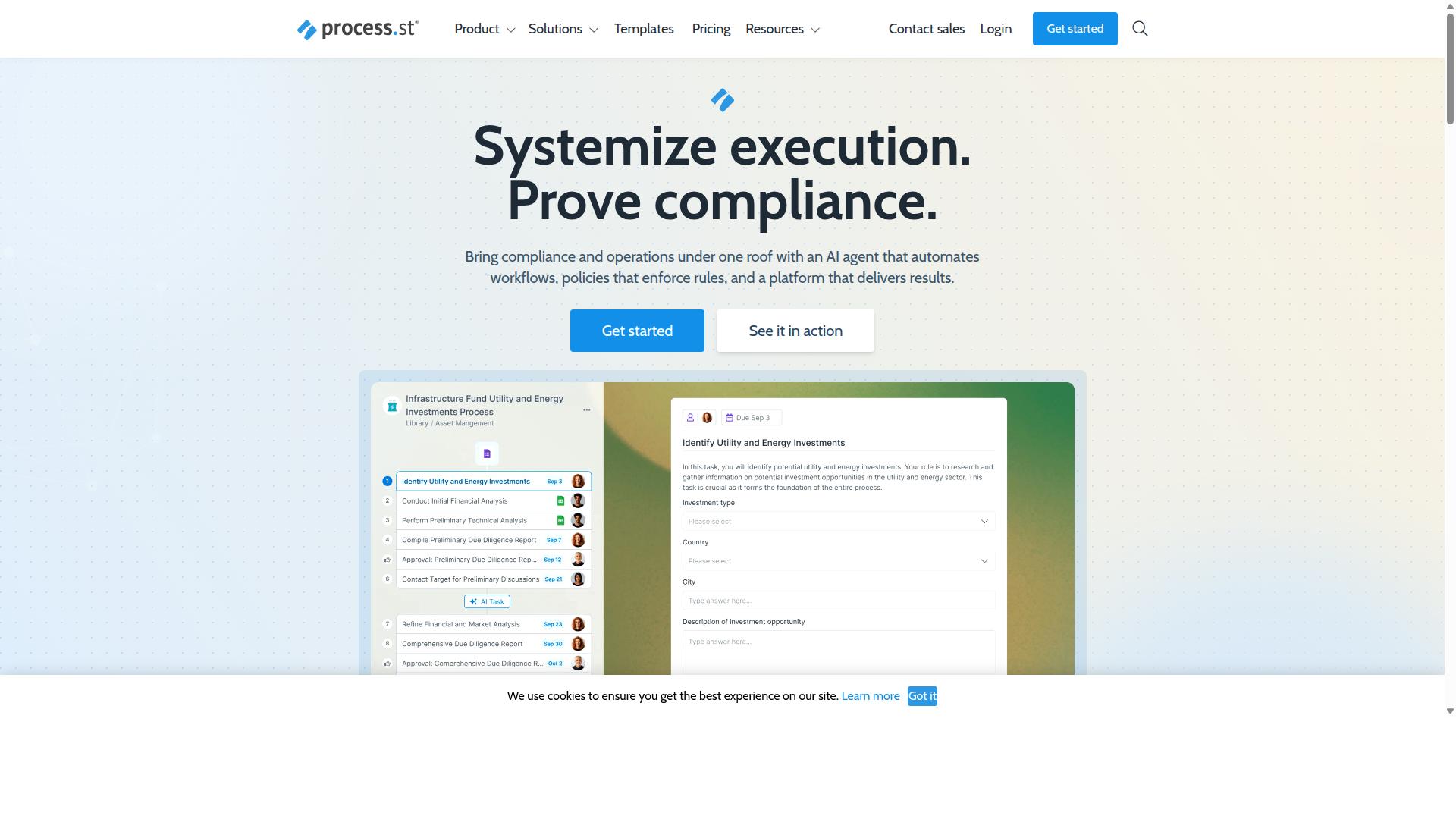
Process Street earns the top ranking by combining workflow automation, AI-driven compliance, and document governance into a single platform trusted by 3,000+ organizations.
The platform serves 1 million-plus active users. It delivers three core products that address document control, workflow automation, and continuous compliance monitoring.
IMCD UK achieved a 75 percent reduction in setup time. Documentation processes ran 30 percent faster after adoption.
Process Street Ops for Enterprise Workflow Orchestration
Ops converts static policies into AI-powered, event-driven workflows that orchestrate tasks across microservices and external systems.
The low-code builder supports 100-plus native integrations with Kafka and REST endpoints. Teams connect existing systems without writing extensive code.
Containerized runners deploy on-prem or inside customer Kubernetes clusters. This approach supports hybrid cloud and on-premise enterprise deployments.
Conditional branching with SLA timers auto-escalates tasks after configurable thresholds. Organizations maintain throughput while meeting strict service commitments.
Process Street Cora AI Compliance Agent
Cora continuously monitors running workflows for policy violations and surfaces real-time alerts with linked audit evidence.
The agent applies machine learning to detect 40-plus compliance patterns. It covers ISO 9001, SOC 2, SOX, and FDA requirements without manual checking.
Every alert includes immutable audit trails that carry timestamps and user attribution. External auditors receive complete, time-stamped records on demand.
Process Street Docs for Governance and Policy Control
Docs centralizes policy storage, version control, and approval workflows while linking every document revision to related active processes.
Granular SSO and SCIM provisioning support directories with 50,000-plus seats. Large organizations manage access at enterprise scale.
Policy-to-task linking automatically triggers training when documents update. This connection ensures staff always work from current procedures.
Immutable change logs remain available for seven years. Exportable evidence packs arrive formatted for external auditors, eliminating manual preparation.
2. Camunda
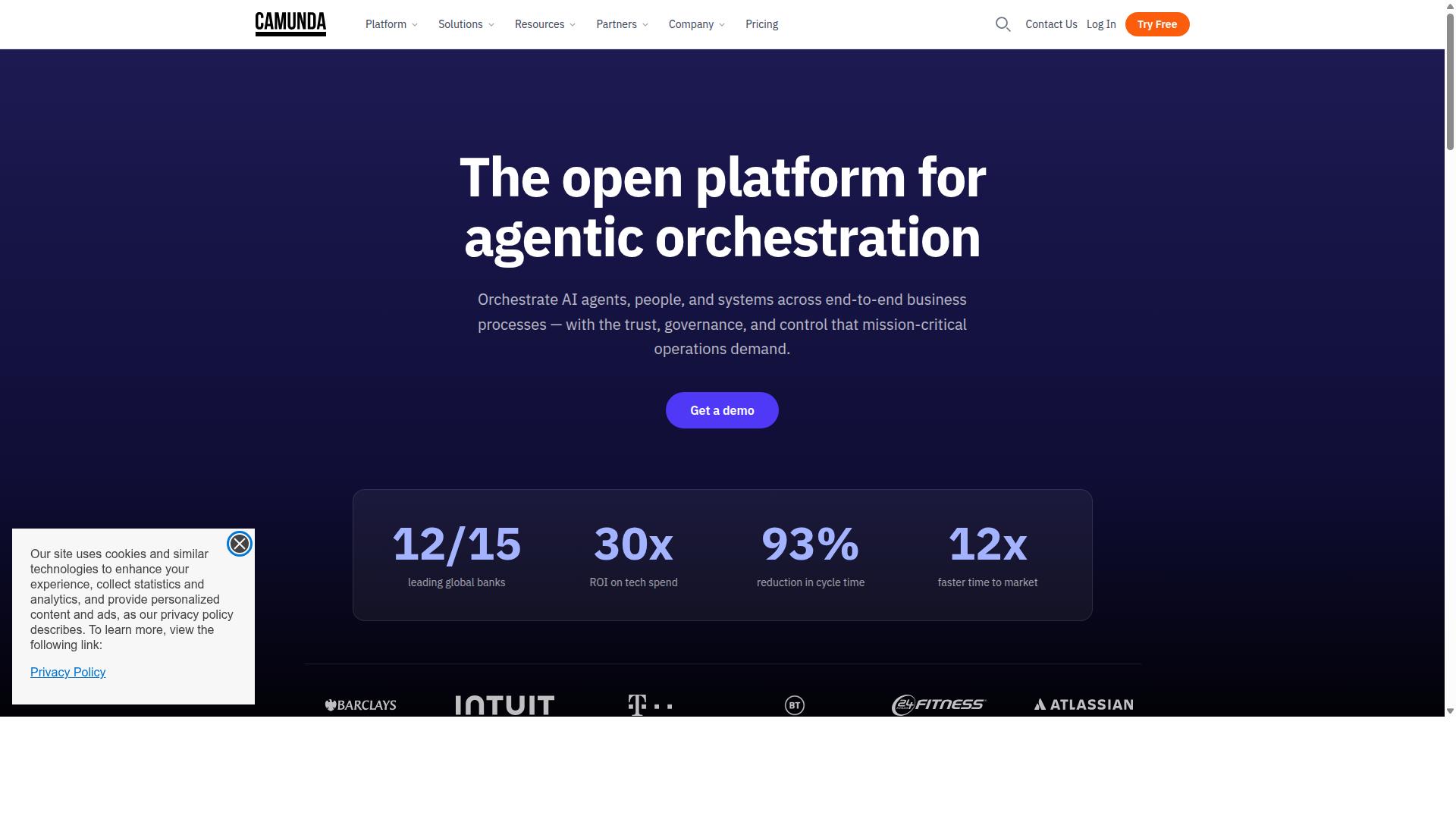
Camunda offers an open-source BPM engine optimized for developers who embed workflow execution directly inside microservice architectures.
The platform delivers three technical strengths that match large-scale enterprise needs. Native BPMN 2.0 execution with DMN decision tables lets teams model, test, and run complex processes without custom code. This approach supports deterministic paths while allowing dynamic routing when conditions change.
Its horizontally scalable Zeebe engine runs on Kubernetes, giving high availability and disaster recovery across hybrid cloud or on-premise setups. Containerization means teams can add nodes during peak loads or deploy across regions without manual reconfiguration.
REST and gRPC APIs integrate Camunda into existing CI/CD pipelines. Developers can trigger workflows from build scripts, monitor jobs through observability tools, and roll back changes using the same release process used for microservices.
Pricing and support models vary by deployment choice. Organizations can run the open-source version themselves or move to managed options that include support contracts and additional tooling. The choice depends on internal DevOps capacity and compliance requirements.
How to Choose the Right Option
Selecting the correct platform requires mapping functional gaps to concrete technical and compliance requirements before issuing RFPs.
Start by cataloging every compliance certification your industry demands. Financial services, healthcare, and capital markets teams must verify SOC 2 Type II, ISO 27001, and GDPR data-residency zones before any vendor reaches the shortlist.
- Document mandatory compliance certifications and required data-residency regions for every operating jurisdiction.
- Benchmark average workflow latency against a 200 ms target under projected peak loads.
- Verify RBAC depth plus SSO, SAML, and SCIM support for every existing identity provider in your stack.
- Calculate total cost of ownership including automation action volumes and user tiers across three-year contracts.
- Run a 30-day proof-of-concept using production data volumes and integration patterns.
Operations, customer management, and compliance teams in manufacturing, real estate, and professional services often face the same latency and residency constraints. Each requirement becomes a filter that narrows the vendor pool quickly.
Latency testing should simulate real event-driven traffic and message queue bursts rather than synthetic benchmarks. Teams that skip this step frequently discover throughput ceilings only after deployment.
RBAC configuration must align with existing directory services. Most enterprise deployments now require granular role hierarchies plus SCIM provisioning to avoid manual user management at scale.
Total cost calculations should factor in both automation action volumes and tiered user pricing. Hidden costs often surface around API calls, storage growth, and additional integration connectors.
The final 30-day proof-of-concept serves as the ultimate validation gate. Process Street supports employee onboarding, client onboarding, ISO compliance, quality tracking, document control, and custom workflows across financial services, healthcare, technology, and property management sectors.
Final Verdict
Process Street stands out for organizations that need unified workflow automation, AI compliance monitoring, and policy governance within a single SOC 2 Type II and ISO 27001-certified platform.
The platform delivers three metrics that matter for enterprise scale. Over 49,000 employees have moved through standardized checklists, which shows proven capacity for large deployments. Users report a 75% reduction in setup time, and the system carries SOC 2 Type II plus ISO 27001 certifications.
Teams that focus on end-to-end audit readiness should start with a guided evaluation using the contact channels below. These numbers reflect real-world outcomes reported by IMCD UK and other enterprise users.
Recommended Resources: